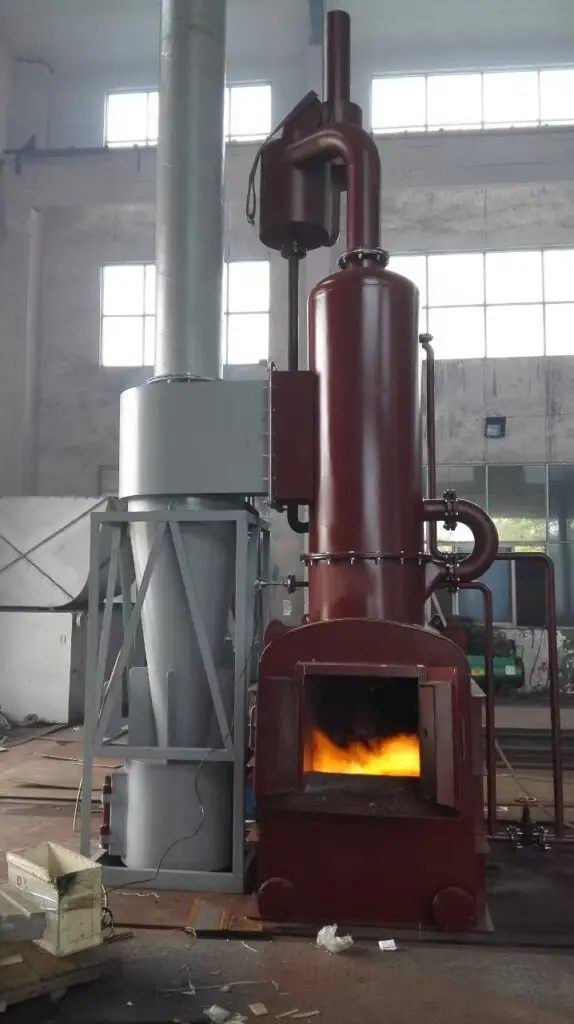
INCINERATOR
FROM WASTE TO ENERGY
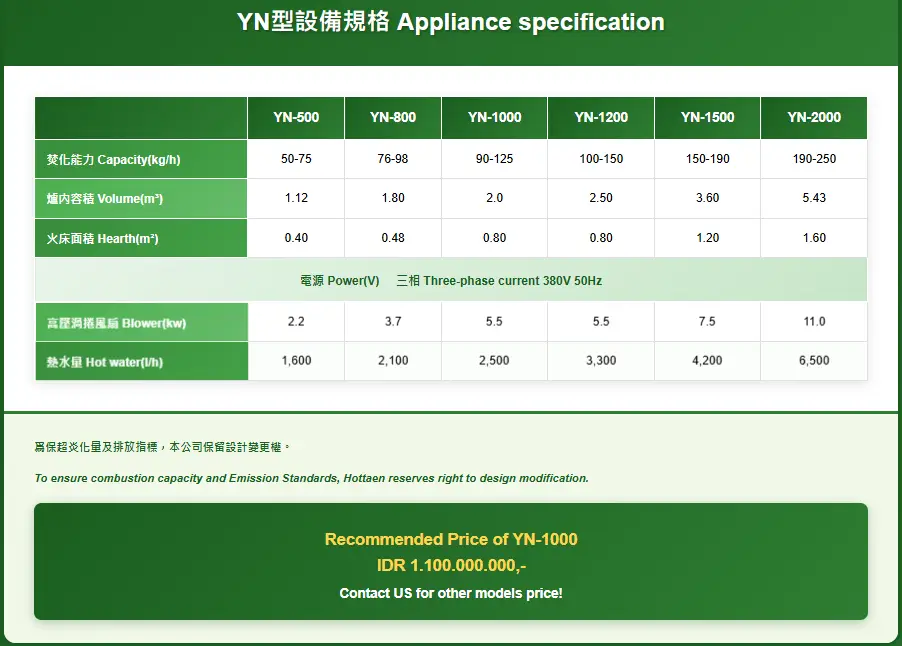
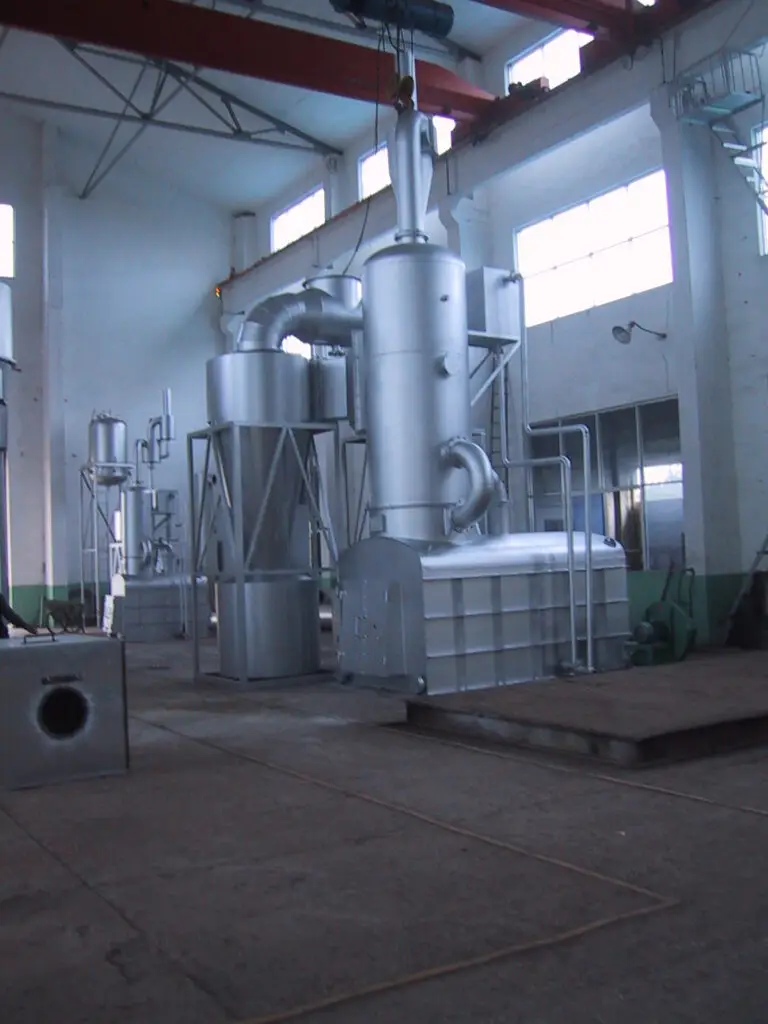
Machine area 3x3m
Turn waste into energy! Our innovative incinerator system transforms waste into a sustainable fuel source for hot water generation. Efficient, eco-friendly, and designed for long-term sustainability.
WHAT IS INCINERATOR ?
An incinerator is a device or facility used to destroy waste through a high-temperature combustion process, significantly reducing the waste’s volume and weight. This technology is often used to manage waste that is difficult to handle or hazardous, with the aim of reducing environmental pollution.
Main Functions of an Incinerator :
- Reduce waste volume, combustion can reduce waste volume by up to 90% and weight by up to 75%.
- Destroy hazardous substances – effectively neutralizes pathogens, toxic chemicals, and medical waste.
- Produce energy – heat generated from combustion can be used to produce steam, electricity, or hot water (waste-to-energy).
- Minimize pollution – with the right filtration technology, emissions can be controlled to be more environmentally friendly.
Types of Waste That Can Be Burned in an Incinerator :
- Medical Waste – syringes, used bandages, body parts, and hospital waste.
- Municipal Solid Waste household garbage, plastic, paper, textiles, fabric, etc.
- Industrial Waste – solid chemical waste, hazardous packaging, dried sludge from wastewater treatment. Agricultural Waste – crop residues, certain livestock waste.
- Hazardous Waste (B3), used paint, solvents, and toxic chemicals.
Advantages of an Incinerator :
- Reduces the need for landfill space.
- Destroys pathogens and hazardous substances.
- Can be used as an energy source (waste-to-energy).
- Faster process compared to landfilling or composting methods.
Compared to boilers that use gas or oil as fuel, incinerators offer more strategic advantages in the long term. While the initial investment cost of an incinerator is higher, its main benefit lies in the use of free fuel, namely solid waste. This automatically reduces operational costs significantly, unlike boilers which constantly require a supply of gas or oil with fluctuating and generally expensive prices. In addition, incinerators not only generate thermal energy but also reduce the volume of solid waste, helping to cut disposal costs while supporting environmental sustainability. Thus, incinerators are not only more cost-efficient in the long run but also provide added value as a waste management solution that conventional boilers cannot offer.
Incinerator Vs Hot Water Boiler
Our Product (Incinerator) :
- Higher initial investment, but free fuel from solid waste.
- Significant fuel cost savings, especially for users previously relying on oil/gas.
- Capable of reducing solid waste while generating heat energy.
Competitor products (Boiler) :
- Lower initial price, but high operational costs due to oil/gas fuel.
- Does not reduce solid waste.
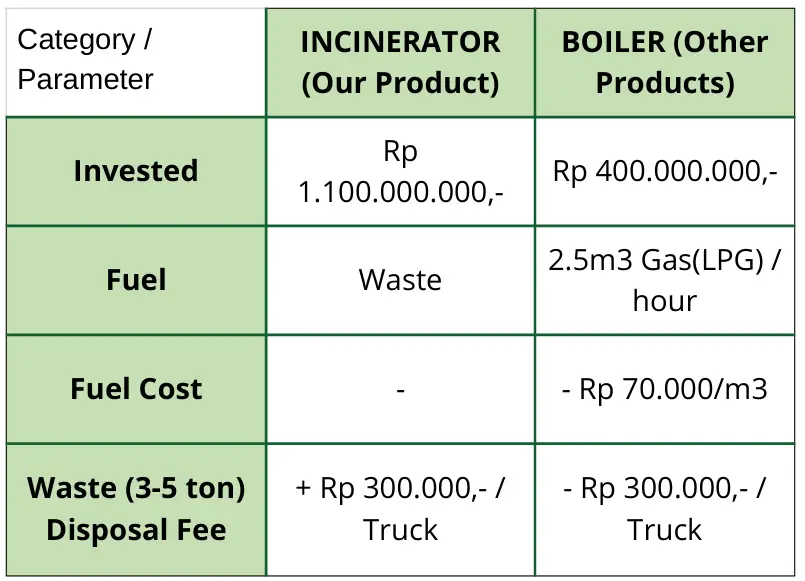
Calculation of Boiler Operational Cost (using LPG fuel):
- Industrial LPG Price = approx. Rp 70,000 / Nm³
- Energy requirement = approx. 2.5 Nm³ of gas per 1 m³ of water (to heat water from 25°C to 80°C)
- Assumption: boiler operates continuously for 24 hours = 70,000 × 2.5 × 24 = Rp 4,200,000
Conclusion:
- Difference in Total Operational Cost:
a. Rp 4,200,000 (fuel cost)
b. Rp 300,000 (waste disposal cost)
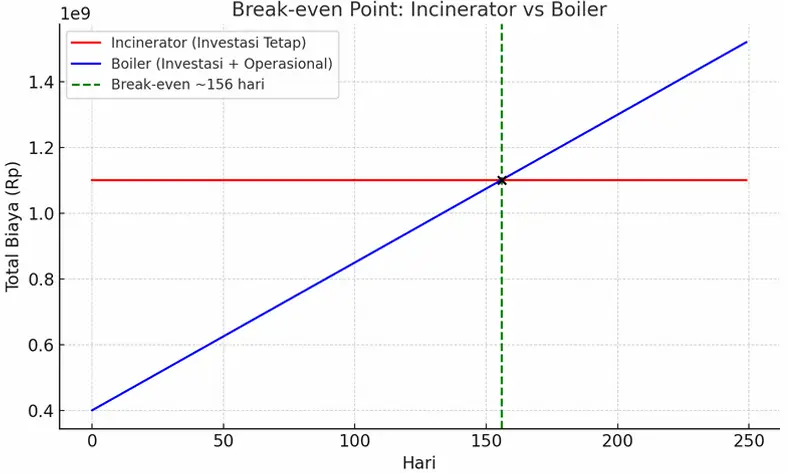
Total = Rp 4,500,000 - Break Even Point (BEP):
a. Formula: (Investment A – Investment B) ÷ Daily Cost Difference
b. (1,100,000,000 – 400,000,000) ÷ 4,500,000 = ±156 days (≈ 5 months)